
How to Get ISO Certified: Steps, Process, Cost & Timeline
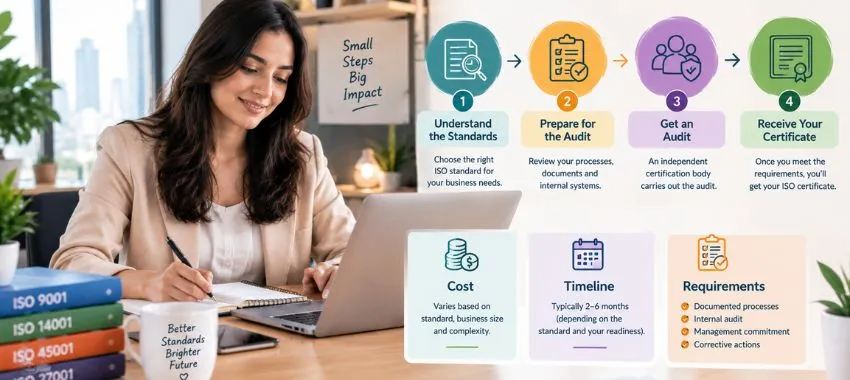
Quick answer: To get ISO certified, pick one standard that matches a real business need, map how your work actually runs, write only the documents you need, collect a few weeks of records, test yourself with an internal audit, then pass a two stage audit by an accredited certification body. Most companies finish in 2 to 6 months, and the cost depends on the audit time your size and risk require.
Most delays in ISO projects have nothing to do with the standard itself. They come from unclear goals, missing owners and records that were never kept. This guide looks at certification from the applicant's side, so you know what to decide, what to prepare and what to expect before an auditor ever visits.
What Is ISO Certification?
ISO certification is a written confirmation from an independent body that your organization works in line with an international standard. ISO writes the rulebook, but it never audits anyone. Accredited certification bodies do that job and issue the certificate. The most common choices are ISO 9001 for quality, ISO 14001 for environment, ISO 45001 for safety, ISO 27001 for information security and ISO 22000 for food safety.
Which ISO Standard Should You Choose?
Start with the problem you need to solve, then pick the standard that answers it.
| If your main goal is | Consider |
|---|---|
| Winning customers who ask for proof of consistent quality | ISO 9001 |
| Cutting environmental risk and waste | ISO 14001 |
| Reducing workplace accidents | ISO 45001 |
| Protecting client and company data | ISO/IEC 27001 |
| Controlling food hazards | ISO 22000 |
ISO Certification Requirements
Every ISO management standard asks the same basic questions. Using ISO 9001 as the model, here is what an auditor wants to know and what you should be ready to show.
| Area | What the auditor wants to know | Evidence to show |
|---|---|---|
| Scope and context | What does your system cover, and who cares about it? | Written scope, list of interested parties |
| Leadership | Does top management really back this? | Signed policy, management meeting records |
| Planning | What can go wrong, and what are you aiming for? | Risk register, measurable objectives |
| Support | Do people have the skills and tools they need? | Training records, equipment logs |
| Operation | Does daily work follow the plan? | Procedures in use, job records, supplier checks |
| Evaluation and improvement | How do you find and fix problems? | Customer feedback, internal audit report, corrective actions |
Records matter more than manuals. A short procedure with real evidence beats a long manual with none.
How to Get ISO Certified: 8 Steps
Step 1: Name your reason
Write down why you want certification, whether it is a customer request, a bid requirement or an internal improvement goal. This reason shapes every later decision.
Step 2: Choose one standard
Resist the urge to chase several at once. One well run system is easier to certify and easier to extend later.
Step 3: Appoint an owner and a sponsor
The owner runs the project day to day. The sponsor, ideally a senior manager, clears roadblocks and shows the team this is a priority.
Step 4: Map how work really happens
Sketch each main process as it runs today, not as you wish it ran. The gaps between the two become your to do list.
Step 5: Write the minimum documents
Cover the policy, objectives, key procedures and a risk register. If a document does not help someone do their job, leave it out.
Step 6: Run the system and collect records
Let your team work the new way for a few weeks. Auditors need to see real records, such as completed forms, training sheets and customer feedback.
Step 7: Test yourself
Carry out an internal audit across every clause, fix what you find, then hold a management review to confirm results and next goals.
Step 8: Choose an accredited body and sit the audit
Confirm the certification body is accredited for your standard, then book the two stage audit. Stage 1 checks readiness and Stage 2 checks that the system works in practice. Any findings are closed with corrective actions before the certificate is issued.
How Much Does ISO Certification Cost?
ISO certification cost is not a single fee. Think of it as three buckets. Getting ready covers your team's time, training and any outside help. Getting audited covers the certification body's fees for the two stage audit. Staying certified covers yearly surveillance audits and a renewal audit at the end of the certificate cycle. Audit fees follow audit time, which depends on your headcount, number of sites and level of risk.
To keep spending under control:
- Keep the scope as tight as your goal allows
- Use your own people where you can instead of buying every service
- Certify related standards together in one integrated system
- Compare written quotes that show audit days and the full certificate cycle, not just the first audit
How Long Does ISO Certification Take?
Most companies finish in 2 to 6 months. Preparation, not the audit, takes the largest share of that time.
| Phase | What happens | Share of total time |
|---|---|---|
| Gap analysis | Compare current practice with the standard | About 5% |
| Build and document | Write policy, procedures and risk register | About 40% |
| Run and collect records | Staff use the system and evidence builds up | About 30% |
| Internal audit and review | Test yourself and close gaps | About 10% |
| Certification audit | Two stages plus closing of findings | About 15% |
Shorter projects usually have a simple scope, one site and an owner with real time to spare. Longer ones involve several sites or a system built from nothing.
ISO Certification for Small Business: How to Get Certified Faster
A small team has a real advantage: decisions are quick and everyone knows how work gets done. Use it. Let one person cover several roles, keep the scope to what customers actually care about and store records in a shared drive instead of buying software. Photos of completed checks, simple spreadsheets and short forms are all acceptable evidence. Finally, ask your certification body whether remote audit options suit your size and risk, since they can reduce travel and scheduling delays.
ISO Certification Checklist: What to Prepare Before the Audit
If you can show each of these in under a minute, you are ready:
- A scope statement approved by top management
- A signed policy that staff can explain in their own words
- Objectives with measured progress
- A reviewed risk and opportunity register
- Procedures that match daily work
- Training and competence records for every role
- An internal audit report with corrective actions closed
- Minutes from a recent management review
- Customer feedback and complaint records
- Supplier evaluation records
Run through this list with your team a week before Stage 1. Anything that takes longer than a minute to find is the first gap to close.
Common Mistakes That Delay Certification
- Copying a template manual: auditors spot generic text quickly
- Leaving ISO to one person: shared ownership keeps the system alive
- Writing procedures nobody follows: the audit checks practice, not paper
- Creating records at the last minute: evidence needs time to build naturally
- Choosing a certifier on price alone: always confirm accreditation first
Final Thoughts
Treat certification as a project with an owner, a deadline and a short list of proof. Choose the standard for a real reason, keep the system simple and let your records speak for you. When you are ready, ask an accredited certification body for a written quote based on your headcount, sites and chosen standard.
Frequently Asked Questions (FAQs)
What is the first step to get ISO certified?
Decide why you need certification and which one standard fits that reason. Everything else, from scope to budget, follows from that choice.
Can one company hold more than one ISO certificate?
Yes. Many companies combine quality, environment and safety standards in one integrated system, which avoids duplicate documents and can reduce audit effort.
Do I need special software to manage ISO documents?
No. Shared folders, spreadsheets and simple forms work well for most small teams. Software only helps when volume or locations make manual control hard.
Who should be on the ISO project team?
A senior sponsor, one project owner and a representative from each main department. Include the people who do the work, not only managers.
What is the difference between ISO certified and ISO compliant?
Certified means an accredited body audited you and issued a certificate. Compliant is only your own claim.
- What Is ISO 28000:2022 in Qatar?
- How to Get ISO Certified? Steps, Cost, Timeline & Requirements
- ISO 9001:2015 vs ISO 9001:2026: What Is the Difference?
- Why Choose Green Quality Services in Qatar?
- Benefits of Integrated Management System
- Which Quality Control Courses in Qatar Will Help You Get Certified Fast?
- What Are the Top 5 Popular ISO Standards in Qatar for 2026?
- Top ISO Courses to Boost Your Career in 2026 (Complete Guide)
- ISO Certification vs CE Marking – Which One Do You Need?
- Is Food Safety Level 3 Worth It?
- Is Food Master Qatar Aligned with International ISO Food Safety Regulations?
- How to Choose the Right ISO Certification Body in Qatar?
- How Third-Party Inspection Ensures Product Quality
- How Manpower Supply in Qatar Supports Business Growth in 2026
- How IRCA Lead Auditor Training in Qatar Boosts Your Audit Skills?
- How Does Infinity Quality Services Qatar Support Qatar Vision 2030
- How Does HACCP Level 3 Improve Food Safety in Qatar?
- What Are the Best Facility Management Courses in Qatar and How Can They Grow Your Career?