
ISO Certification vs CE Marking – Which One Do You Need?
Introduction
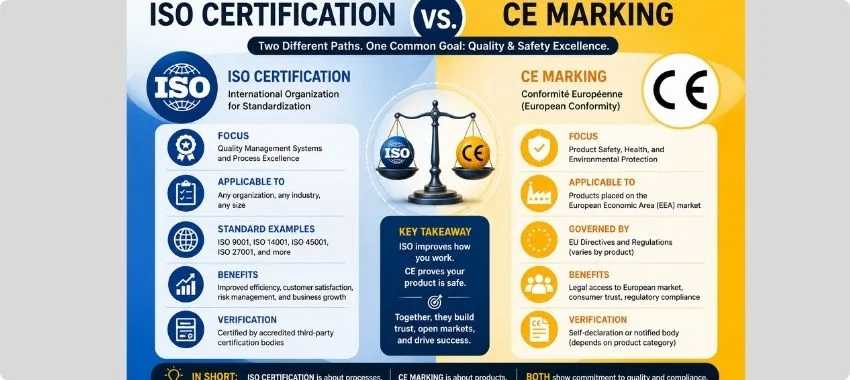
Organizations that work across international markets may encounter both ISO management system certification and CE marking. Although both relate to conformity and recognized requirements, they serve different purposes.
ISO management system certification relates to an organization's management system, while CE marking relates to certain products that fall within applicable European product legislation.
The right requirement depends on the organization's activities, the type of product involved and the market in which that product will be placed. Understanding this distinction helps businesses avoid treating ISO certification and CE marking as interchangeable.
What is ISO Certification?
ISO management system standards provide structured requirements for areas such as quality, environmental management and information security. Where a standard is certifiable, an independent certification body can assess an organization's management system against the applicable requirements.
Examples of widely used management system standards include:
- ISO 9001 for Quality Management Systems.
- ISO 14001 for Environmental Management Systems.
- ISO 27001 for Information Security Management Systems.
Certification relates to the organization's management system and should not be confused with product conformity requirements such as CE marking.
What is CE Marking?
CE marking is used for products covered by applicable European Union product legislation. Where CE marking requirements apply, the manufacturer or other responsible economic operator must follow the relevant conformity assessment requirements before the product is placed on the applicable European market.
CE marking relates to products rather than the overall management system of an organization. Depending on the product and applicable legislation, conformity assessment may involve manufacturer assessment, technical documentation, testing or participation of a notified body.
ISO Certification vs CE Marking – Key Differences
The main differences become clearer when the two are compared by purpose, scope and application.
1. Purpose and Focus
- ISO management system certification assesses whether an organization's management system conforms to the applicable certification requirements.
- CE marking relates to conformity of products covered by applicable European product legislation.
2. Applicability
- ISO management system certification applies to the management system and certified scope of an organization.
- CE marking applies to products for which relevant European Union requirements apply.
3. Voluntary vs Mandatory
- ISO management system certification is generally voluntary, although customers, contracts, tenders or supplier requirements may request a particular certification.
- CE marking is required where applicable European Union product legislation requires it for the product being placed on the relevant market.
4. Geographical Scope
- ISO management system certifications are used internationally, although acceptance requirements may vary between customers, contracts and markets.
- CE marking applies within the framework of relevant European Union product legislation and market access requirements.
5. Assessment Process
- Management system certification involves assessment by a certification body against the applicable standard and certification requirements.
- CE conformity assessment depends on the applicable product legislation and may involve manufacturer assessment or third party involvement where required.
When Might an Organization Consider ISO Certification?
An organization may consider certification when a relevant management system standard supports its operational needs or when certification is requested by a customer, contract, supplier registration process or other interested party.
- When a management system needs independent assessment.
- When customers or contracts specify certification requirements.
- When the organization wants external confirmation of conformity with a particular management system standard.
- When certification forms part of supplier or procurement requirements.
When Might CE Marking Be Required?
CE marking may be required where a product falls within applicable European Union legislation that requires CE marking before the product can be placed on the relevant market.
- The product falls within applicable European product legislation.
- The applicable conformity assessment requirements have been identified.
- Required technical documentation and evidence have been prepared.
- Any required third party assessment has been completed where applicable.
The exact obligations depend on the product category and the legislation that applies to it.
ISO Certification vs CE Marking – Can You Have Both?
Yes. An organization may have a certified management system while also placing products on the European market that require CE marking. The two serve different purposes and one does not replace the other.
For example, a manufacturer may operate a quality management system assessed against ISO 9001 while separately completing the applicable conformity assessment requirements for a product that requires CE marking.
Whether either requirement applies depends on the organization, the relevant management system standard, the product and the market in which the product will be placed.
What ISO Management System Certification Demonstrates
- An independent assessment has been conducted against the applicable certification requirements.
- The certified scope identifies the activities covered by the certification.
- The management system is subject to the applicable certification cycle and ongoing assessment requirements.
- The certificate provides a defined reference to the relevant management system standard.
What CE Marking Demonstrates
- The manufacturer has addressed the applicable conformity requirements for the product.
- Required conformity assessment procedures have been followed.
- Technical documentation and supporting evidence have been prepared where required.
- The product may carry the CE marking where all applicable requirements have been satisfied.
Does ISO Certification Replace CE Marking?
No. Management system certification and CE marking address different areas. A certified management system does not remove product conformity obligations where CE marking requirements apply.
Likewise, CE marking on a product does not demonstrate that the organization operates a certified management system unless a separate management system certification has been completed.
How to Determine Which Requirement Applies
Organizations should first identify whether the requirement relates to the organization's management system or to a specific product.
- Review customer and contractual requirements.
- Identify the management system standard relevant to the organization, if any.
- Determine whether the product falls within applicable European product legislation.
- Review the conformity assessment route relevant to the product.
- Confirm whether independent certification or notified body involvement is required.
Conclusion
ISO management system certification and CE marking address different requirements. Management system certification relates to an organization's management system, while CE marking relates to product conformity under applicable European product legislation.
An organization should first determine which requirements apply to its management system, products and intended markets rather than treating ISO certification and CE marking as interchangeable alternatives.
Organizations looking for independent management system assessment can learn more about NORMEIRA's ISO certification services.
FAQ
What is the difference between ISO Certification and CE Marking?
ISO management system certification relates to an organization's management system, while CE marking relates to conformity of products covered by applicable European product legislation.
Is ISO management system certification mandatory?
Certification is generally voluntary, although a customer, contract, tender or supplier requirement may require a particular certification.
Is CE Marking mandatory?
CE marking is required for products covered by applicable European Union product legislation when the relevant conditions for placing those products on the market are met.
Can a company have both ISO Certification and CE Marking?
Yes. An organization may have a certified management system while also placing products on the market that require CE marking.
Does ISO Certification replace CE Marking?
No. They serve different purposes, and management system certification does not replace applicable product conformity requirements.
- ISO 9001:2015 vs ISO 9001:2026: What Is the Difference?
- Why Choose Green Quality Services in Qatar?
- Benefits of Integrated Management System
- Which Quality Control Courses in Qatar Will Help You Get Certified Fast?
- What Are the Top 5 Popular ISO Standards in Qatar for 2026?
- Top ISO Courses to Boost Your Career in 2026 (Complete Guide)
- ISO Certification vs CE Marking – Which One Do You Need?
- Is Food Safety Level 3 Worth It?
- Is Food Master Qatar Aligned with International ISO Food Safety Regulations?
- How to Choose the Right ISO Certification Body in Qatar?
- How Third-Party Inspection Ensures Product Quality
- How Manpower Supply in Qatar Supports Business Growth in 2026
- How IRCA Lead Auditor Training in Qatar Boosts Your Audit Skills?
- How Does Infinity Quality Services Qatar Support Qatar Vision 2030
- How Does HACCP Level 3 Improve Food Safety in Qatar?
- What Are the Best Facility Management Courses in Qatar and How Can They Grow Your Career?